Reference file
Reference file

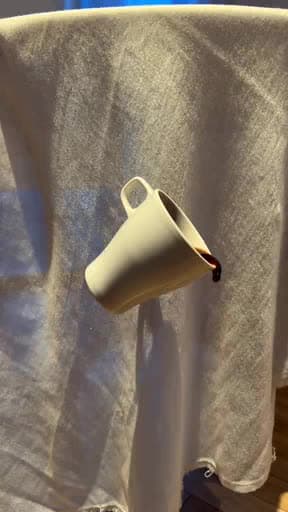
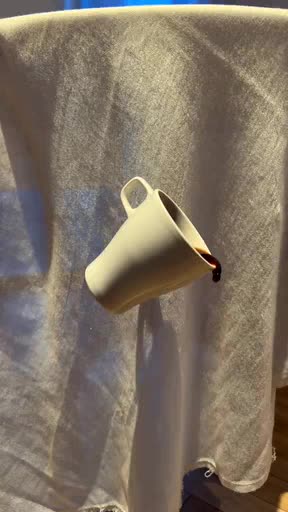
Use @Image1 only for the white ceramic mug's shape, glaze, and proportions — no hand, no arm, no skin visible anywhere in the frame. Use @Image2 only for the fabric and light mood: soft beige linen with warm sunlight and cool blue-toned shadow bands moving across it. The entire video is filmed in continuous extreme slow motion, equivalent to an ultra-high-speed 2000fps capture. This slow motion captures real continuous motion at extremely high temporal resolution — nothing holds a static or frozen shape, and nothing ever snaps or resolves quickly. The moment the mug fractures is the slowest, most extended moment in the entire shot — even slower and more drawn-out than the fall before it, given the most screen time of anything in the video. A plain white ceramic mug filled with dark coffee enters the frame in its upper third and falls downward, covering clearly visible vertical distance — never static or hovering. As it falls, the mug tips naturally onto its side in a single smooth tilt, one gradual rotation only, no spinning or tumbling, so by the time it nears the floor it is oriented sideways. All coffee visible in the shot comes only from inside the mug and only spills out through its rim, at the point where the rim tilts lowest — no coffee stream, jet, or liquid enters the frame from above or off-screen. Coffee dribbles and spills naturally over the low edge of the rim under gravity, a soft gravity-led cascade staying visually attached to the rim as it falls. Behind and around the mug, soft linen fabric drifts and ripples gently in the same slow motion, warm sunlight and cool blue shadow bands sliding slowly across its weave. As the mug nears the bottom of its fall, a warm wood floor surface comes into view beneath it, matching natural wood tones and grain. The camera falls together with the mug in one continuous tracking shot at matching downward speed, keeping the mug roughly centered as the linen fabric streams past behind it and the floor rises into view below. The mug lands on its side against the wood floor, striking along its curved body and rim. From this point, the breaking sequence stretches out and becomes the most extreme slow motion in the entire video: the first hairline cracks appear and visibly creep and branch across the ceramic surface over an extended, clearly readable duration — this is not instant. The mug then separates into many small, irregular fragments — at least fifteen to twenty pieces of varied sizes, from larger curved wall sections down to small chips and fine ceramic dust — with each fragment slowly peeling away from its neighbors and drifting outward individually, rough jagged chalky-white break lines visible on every edge, not a clean two- or three-piece split. At the same time, the coffee still in the mug releases from the break point and splashes outward across the floor in an irregular, natural pattern, every droplet, arc, and spray individually trackable and unhurried as it separates and falls. Shards drift outward, catch the light, and only gradually settle or come to rest, with fine dust hanging suspended in the air the longest. Every coffee droplet and ceramic fragment is individually resolved and sharply defined at each frame, with no motion blur trails and no frame stutter, while constantly and visibly moving — the breaking moment in particular should feel stretched, suspended, almost meditative, like time has nearly stopped exactly when the mug shatters. Push realism further: render this as if shot on a real high-speed cinema camera — subtle natural film grain, faint imperfect lens characteristics, natural shallow depth of field, realistic sub-surface light scatter inside the coffee, accurate reflections and refractions on wet ceramic and liquid surfaces, natural micro-variation in fabric and wood textures. The ceramic keeps a real matte-to-satin porcelain glaze; the coffee has real liquid viscosity and weight. Avoid any plastic, over-smoothed, or synthetic digital appearance anywhere in the frame. Audio: near total silence through the fall, a sharp real ceramic-on-wood impact crack right as contact begins, then a extended quiet hush with faint individual crackle and settling sounds stretched across the entire slow breaking sequence. No music, no score. Keep everything physically grounded and natural, with the fracture itself as the clear slow-motion centerpiece of the whole video.

Use @Image1 only for the white ceramic mug's shape, glaze, and proportions — no hand, no arm, no skin visible anywhere in the frame. Use @Image2 only for the fabric and light mood: soft beige linen with warm sunlight and cool blue-toned shadow bands moving across it. The entire video is filmed in continuous extreme slow motion, equivalent to an ultra-high-speed 2000fps capture. This slow motion captures real continuous motion at extremely high temporal resolution — nothing holds a static or frozen shape, and nothing ever snaps or resolves quickly. The moment the mug fractures is the slowest, most extended moment in the entire shot — even slower and more drawn-out than the fall before it, given the most screen time of anything in the video. A plain white ceramic mug filled with dark coffee enters the frame in its upper third and falls downward, covering clearly visible vertical distance — never static or hovering. As it falls, the mug tips naturally onto its side in a single smooth tilt, one gradual rotation only, no spinning or tumbling, so by the time it nears the floor it is oriented sideways. All coffee visible in the shot comes only from inside the mug and only spills out through its rim, at the point where the rim tilts lowest — no coffee stream, jet, or liquid enters the frame from above or off-screen. Coffee dribbles and spills naturally over the low edge of the rim under gravity, a soft gravity-led cascade staying visually attached to the rim as it falls. Behind and around the mug, soft linen fabric drifts and ripples gently in the same slow motion, warm sunlight and cool blue shadow bands sliding slowly across its weave. As the mug nears the bottom of its fall, a warm wood floor surface comes into view beneath it, matching natural wood tones and grain. The camera falls together with the mug in one continuous tracking shot at matching downward speed, keeping the mug roughly centered as the linen fabric streams past behind it and the floor rises into view below. The mug lands on its side against the wood floor, striking along its curved body and rim. From this point, the breaking sequence stretches out and becomes the most extreme slow motion in the entire video: the first hairline cracks appear and visibly creep and branch across the ceramic surface over an extended, clearly readable duration — this is not instant. The mug then separates into many small, irregular fragments — at least fifteen to twenty pieces of varied sizes, from larger curved wall sections down to small chips and fine ceramic dust — with each fragment slowly peeling away from its neighbors and drifting outward individually, rough jagged chalky-white break lines visible on every edge, not a clean two- or three-piece split. At the same time, the coffee still in the mug releases from the break point and splashes outward across the floor in an irregular, natural pattern, every droplet, arc, and spray individually trackable and unhurried as it separates and falls. Shards drift outward, catch the light, and only gradually settle or come to rest, with fine dust hanging suspended in the air the longest. Every coffee droplet and ceramic fragment is individually resolved and sharply defined at each frame, with no motion blur trails and no frame stutter, while constantly and visibly moving — the breaking moment in particular should feel stretched, suspended, almost meditative, like time has nearly stopped exactly when the mug shatters. Push realism further: render this as if shot on a real high-speed cinema camera — subtle natural film grain, faint imperfect lens characteristics, natural shallow depth of field, realistic sub-surface light scatter inside the coffee, accurate reflections and refractions on wet ceramic and liquid surfaces, natural micro-variation in fabric and wood textures. The ceramic keeps a real matte-to-satin porcelain glaze; the coffee has real liquid viscosity and weight. Avoid any plastic, over-smoothed, or synthetic digital appearance anywhere in the frame. Audio: near total silence through the fall, a sharp real ceramic-on-wood impact crack right as contact begins, then a extended quiet hush with faint individual crackle and settling sounds stretched across the entire slow breaking sequence. No music, no score. Keep everything physically grounded and natural, with the fracture itself as the clear slow-motion centerpiece of the whole video.

Creation date
July 9, 2026, 21:48
Aspect ratio
9:16
Resolution
1080×1920
0:00 / 0:00